
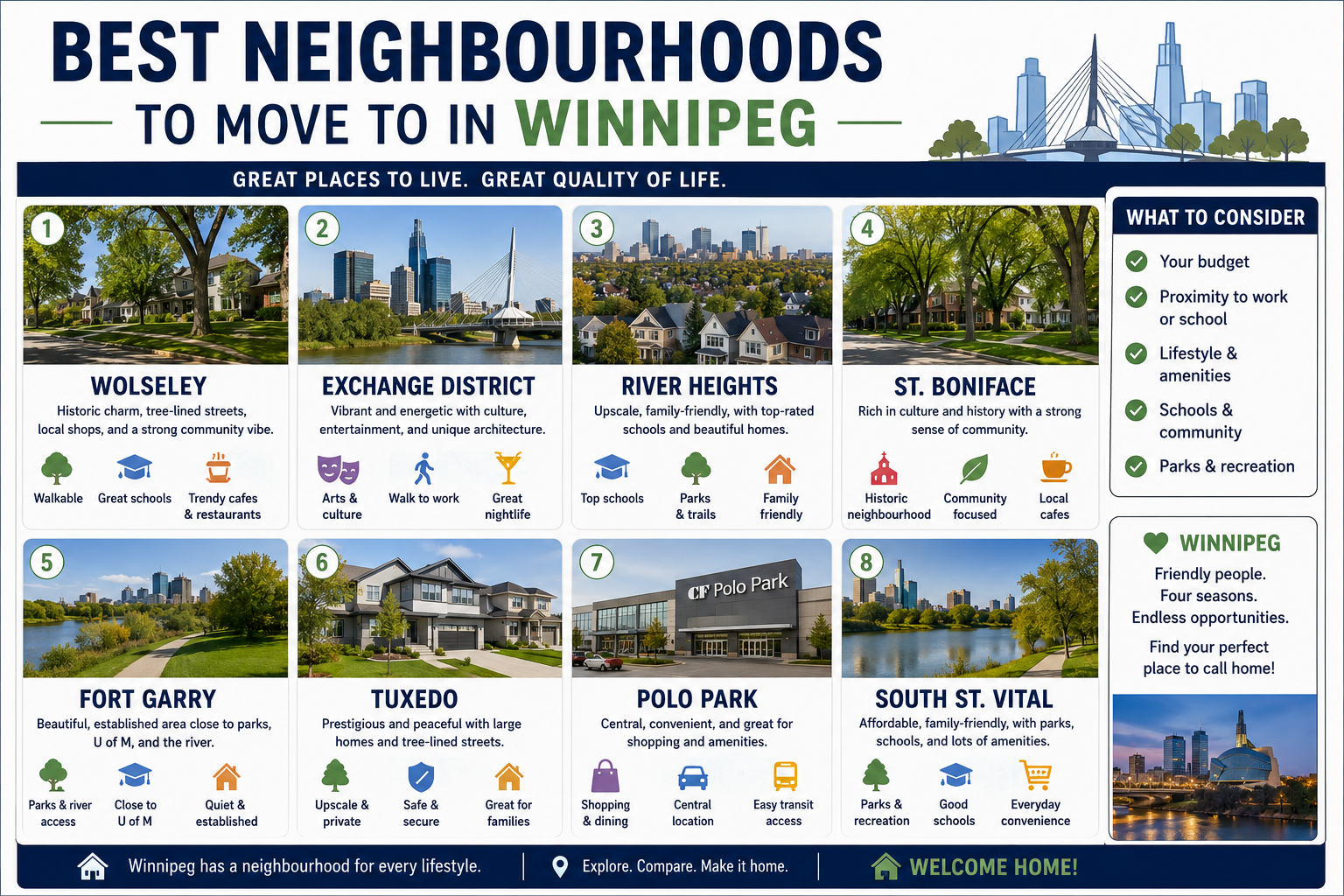
You’ve got boxes half-packed, a school transfer form on the counter, and your partner asking “are we making the right call?” That pressure is real. Picking the wrong neighbourhood in Winnipeg means your kids end up at a school you didn’t want, your commute doubles, and you’re stuck for years regretting the decision. The best neighbourhoods to move to in Winnipeg in 2026 aren’t the ones with the flashiest listings — they’re the ones that actually fit how your family lives. Here’s the honest breakdown.
What Makes a Winnipeg Neighbourhood Worth Moving to in 2026?
Winnipeg has grown faster than most people expected. New transit corridors, school upgrades, and infrastructure work have quietly shifted which areas offer real value. The best neighbourhoods to move to in Winnipeg in 2026 share a few things: walkable amenities, solid schools, reasonable commute times, and that feeling of actually knowing your neighbours.
Before you sign anything, check how a neighbourhood scores on the Statistics Canada Community Profiles — it gives you income distribution, population density, and age breakdown that no real estate listing will tell you.
Which Winnipeg Neighbourhood Is Best for Families with Young Kids?
Waverley West keeps coming up, and for good reason.
This southwest neighbourhood has seen the most new school construction in the city over the last five years. Parents moving here aren’t gambling — they’re walking their kids to schools that were built in the last decade, with proper facilities.
The roads connect well to Kenaston Boulevard, grocery stores are within a short drive, and the housing stock ranges from newer townhomes to detached houses with actual yards. If you have kids under ten and you’re relocating to Winnipeg, Waverley West deserves serious attention.
One thing people miss: the neighbourhood is still expanding. That means new parks, new playgrounds, and more families landing there every month — community builds quickly when everyone’s new.
Is River Heights Still Worth It in 2026?
Yes, but know what you’re buying.
River Heights is one of the best neighbourhoods to move to in Winnipeg in 2026 if you want character, mature trees, and walkability. The homes are older, which means charm and quirks in equal measure. You’ll get hardwood floors and big lots. You’ll also get a furnace that might need attention.
The area sits close to Corydon Avenue — coffee shops, restaurants, independent stores. It doesn’t feel suburban. If you’re a young professional or a couple without kids, this neighbourhood fits differently than Waverley West does.
Renters have good options here too. The mix of housing types keeps the area from feeling homogenous.
What About Transcona for Budget-Conscious Movers?
Transcona sits in the east end and consistently offers lower entry prices than the city’s more talked-about areas. That makes it one of the best neighbourhoods to move to in Winnipeg in 2026 for first-time buyers or families stretching their budget.
The community has a strong identity — people from Transcona tend to stay in Transcona. Local shops, community centres, and schools have loyal followings. It’s not trendy, but it’s solid.
The tradeoff is commute time if you’re working downtown. Plan that into your decision. But if you work in the east end or from home, Transcona makes financial sense without sacrificing community feel.
Is St. Vital a Safe Bet for 2026?
St. Vital rarely gets the press it deserves.
It sits in the southeast, borders the Red River, and has Southdale and Windsor Park folded into its broader area. The school options are strong, the streets feel established, and St. Vital Centre gives you practical shopping without needing to drive across the city.
For families prioritizing stability over trendiness, St. Vital is one of the best neighbourhoods to move to in Winnipeg in 2026. The housing mix includes bungalows, split-levels, and newer builds depending on which pocket you land in.
If you have elderly parents who might visit or eventually move nearby, the accessibility of the area — flat terrain, good bus routes, medical clinics — makes it thoughtful choice-making, not just convenient.
What Is the Safest and Most Walkable Area Near Downtown Winnipeg?
Osborne Village and Fort Rouge answer that question well.
These two overlap in feel. Both sit close enough to downtown that car dependency drops significantly. Osborne Village especially has a density of services — pharmacy, gym, restaurants, transit — that lets residents genuinely go car-light.
These are among the best neighbourhoods to move to in Winnipeg in 2026 for people who want urban living without full downtown density. Rents run higher here than in the suburbs, but you offset that with lower transportation costs.
For newcomers to Canada settling in Winnipeg, this part of the city often becomes home first because services are accessible. The Government of Canada’s settlement services can help connect you with local supports as you get established.
How Do You Actually Plan a Move to a New Winnipeg Neighbourhood?
Planning matters more than most people admit until they’re in the middle of moving day chaos. Here’s a simple process that works:
Step 1 — Visit before you commit. Drive or walk your target neighbourhood on a Tuesday morning and a Saturday afternoon. Different energy. Trust both.
Step 2 — Check school boundaries directly. Winnipeg School Division and Louis Riel School Division both have boundary tools online. Don’t assume proximity means enrollment.
Step 3 — Research the transit route. Winnipeg Transit’s online trip planner shows you real commute times from any address.
Step 4 — Plan your moving logistics early. Winnipeg winters are not forgiving. If you’re moving between October and March, book your moving services well ahead. Icy driveways, packed elevators in condo buildings, and short daylight hours all add time. A local team that does packing and moving Winnipeg takes the physical load off so you can focus on the transition itself.
Step 5 — Update your address with CRA and provincial services. Use My Account on the CRA website to update your address for tax purposes. Manitoba residents also need to update their health card and driver’s licence through Manitoba Public Insurance.
Why Local Knowledge Matters More Than Any Ranking List
Swift Mover has helped families move into nearly every neighbourhood on this list. What they see on move day is telling — the neighbour who comes out to hold the door, the family across the street who already knows the best school bus stop, the community Facebook group someone mentions before the truck is even unloaded.
That on-the-ground familiarity is hard to get from a search result. Local movers hear the unfiltered version of neighbourhood life from clients who’ve just arrived and from ones who’ve lived there for years.
The best neighbourhoods to move to in Winnipeg in 2026 aren’t determined by one person’s opinion. They’re shaped by the people already living in them — and the ones choosing to move there now.
Conclusion
Winnipeg is a city that rewards people who take time to understand its neighbourhoods before choosing. Waverley West for growing families who want new infrastructure. River Heights for walkable character. Transcona for budget without compromise on community. St. Vital for stability and access. Osborne Village for urban convenience.
The best neighbourhoods to move to in Winnipeg in 2026 depend on your life — your kids’ ages, your commute, your budget, your pace. No list replaces the walk-through, the school research, and the conversation with someone already living there.
When the decision is made and the boxes are ready, the move itself deserves the same care you put into choosing the neighbourhood. A team that knows Winnipeg’s streets, buildings, and winters makes that day far less stressful — and gives you energy left over to actually enjoy arriving somewhere new.
Frequently Asked Questions
Which Winnipeg neighbourhood has the best schools in 2026?
Waverley West and St. Vital consistently come up for families prioritizing school quality. Both areas have seen recent investment in school infrastructure. Check boundary maps directly with Winnipeg School Division or Louis Riel School Division before making assumptions based on proximity to a school building.
Is Winnipeg a good city to move to in 2026?
Winnipeg offers housing affordability that most Canadian cities can’t match right now. Cost of living is lower than Toronto or Vancouver, the job market spans healthcare, education, and manufacturing, and the community feel in residential neighbourhoods is strong. Winter requires preparation, but it doesn’t stop people from building good lives here.
What is the most affordable neighbourhood in Winnipeg for families?
Transcona in the east end and Elmwood offer the most entry-level pricing for detached homes. Both have established communities and access to schools and transit. They may not have the same media attention as southwest Winnipeg, but the value for families on a tighter budget is real and consistent.
How far in advance should I book moving services in Winnipeg?
For summer moves — May through August — book at least six to eight weeks ahead. For winter moves, four weeks is usually enough but conditions can complicate schedules. Choosing a mover familiar with Winnipeg’s building types and seasonal conditions reduces surprises significantly on move day.
Do I need to update my government information when I move within Winnipeg?
Yes. Even moving across the city requires updating your address with Canada Revenue Agency, Manitoba Health for your health card, and Manitoba Public Insurance for your driver’s licence and vehicle registration. Skipping these creates delays with tax returns, health coverage verification, and renewal notices reaching the wrong address.