
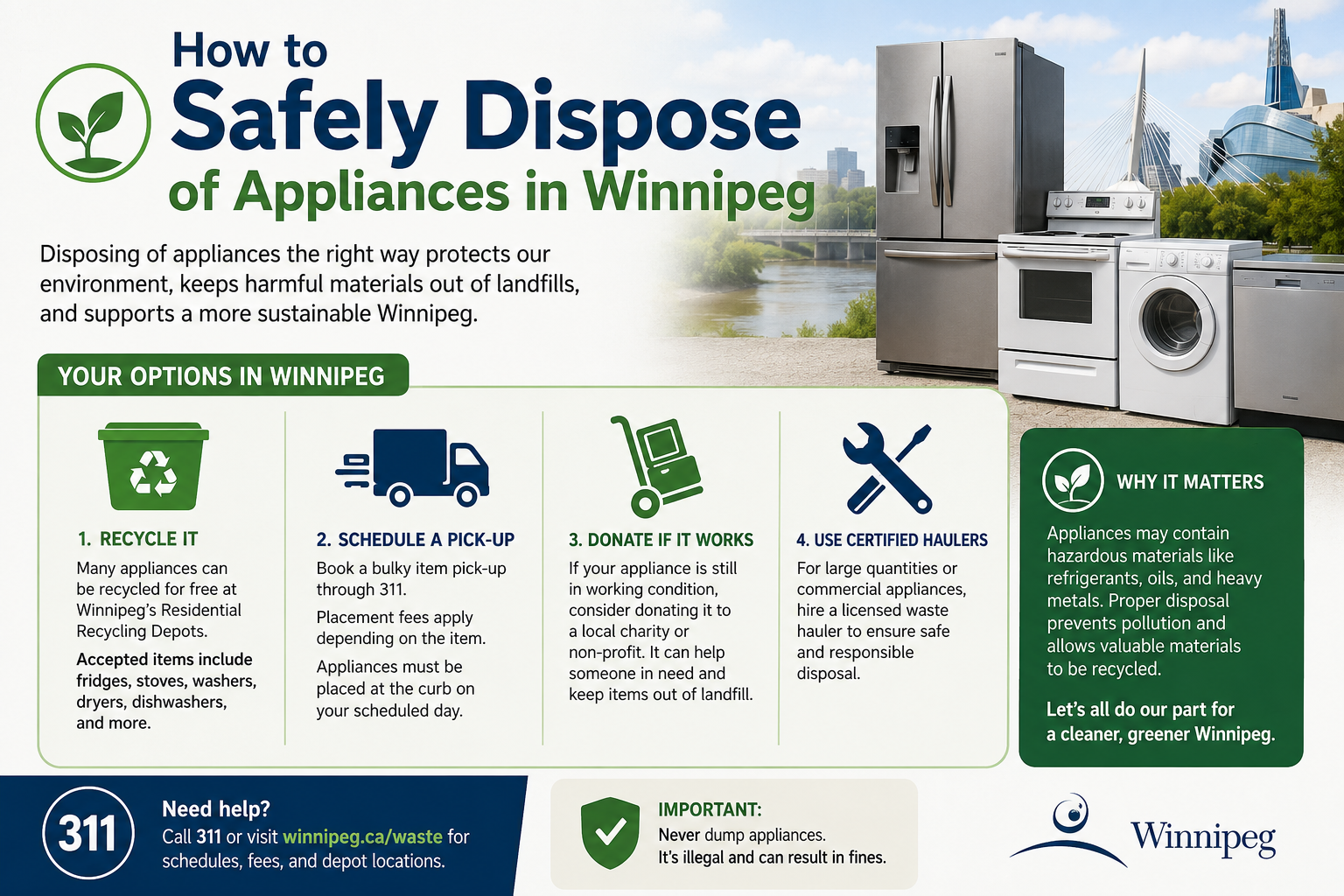
Your old fridge stopped working last Tuesday. Now it’s sitting in your kitchen, taking up space, and nobody knows what to do with it. You can’t just drag it to the curb on garbage day. You can’t leave it in the alley. And calling the city feels like a whole project. If you’ve ever stood in your kitchen staring at a dead appliance wondering what comes next — this guide is written for you. Here’s everything Winnipeg families need to know about how to safely dispose of appliances in Winnipeg, without the stress, fines, or environmental guilt.
Why Can’t You Just Put an Old Appliance on the Curb in Winnipeg?
A lot of people assume large appliance pickup works like regular garbage. It doesn’t.
The City of Winnipeg does not collect appliances as part of standard curbside waste pickup. Large items like refrigerators, stoves, washing machines, and dryers contain materials that need special handling — refrigerants, compressor oils, metals, and plastics that can’t go to a regular landfill.
Leaving an appliance on the curb without authorization can result in a bylaw violation. More than that, it causes real environmental harm. Refrigerants, for example, are greenhouse gases. One improperly dumped fridge can release enough refrigerant to cause lasting damage to local air quality.
The good news? Winnipeg has solid options for doing this the right way.
What Does the City of Winnipeg Actually Offer for Appliance Disposal?
The City of Winnipeg operates four Residential Waste Disposal Facilities (RWDFs) where residents can drop off large appliances free of charge with proof of Winnipeg residency.
These facilities accept:
- Refrigerators and freezers
- Stoves and ovens
- Washing machines and dryers
- Dishwashers
- Air conditioners
You can find facility locations, hours, and acceptable items on the City of Winnipeg Waste Reduction page. Hours change seasonally, so checking before you go saves a wasted trip.
There’s one important requirement: all appliances with refrigerants must be brought in with the refrigerant intact. Don’t try to drain or vent a refrigerator yourself. That’s illegal under federal regulations and genuinely dangerous. If the refrigerant has already been tampered with, the facility may refuse the appliance.
What Happens to Appliances After You Drop Them Off?
When you drop an appliance at a Winnipeg disposal facility, it goes through a regulated process.
Refrigerants are recovered by certified technicians following standards set under the Canadian Environmental Protection Act (CEPA). Metals are separated and sent for recycling. Components that can be reused are pulled out. What’s left — a much smaller amount — goes to landfill.
This process keeps hazardous materials out of the soil and water. It also recovers valuable materials that would otherwise be wasted.
Knowing this makes it easier to follow the rules. You’re not just following regulations — you’re actually protecting the Red River watershed and the broader Prairie ecosystem that Winnipeg sits within.
How to Safely Dispose of Appliances in Winnipeg — Step by Step
Here’s a clean process that works for most Winnipeg households.
Step 1: Identify what you have. Is it a refrigerator, freezer, or air conditioner? These contain refrigerants and need special care. Everything else — stoves, washers, dryers — is simpler but still not curbside material.
Step 2: Check if it still works. A working appliance can be donated. Winnipeg organizations like Habitat for Humanity ReStore accept working appliances. This keeps usable items out of the waste stream entirely.
Step 3: Book a pickup or plan your drop-off. You have two paths — haul it yourself to a City RWDF, or hire a professional appliance removal service. If the appliance is heavy, awkward, or involves stairs and tight hallways, a professional crew makes a lot more sense than risking injury or damaging your floors.
Step 4: Prepare the appliance. Empty the fridge, disconnect it from power, and defrost it if needed. Remove any food, shelving, and loose parts. Don’t try to remove doors from fridges — the facility handles that.
Step 5: Complete the disposal. Whether you drop it off yourself or arrange pickup, make sure you get confirmation that the appliance will be processed correctly. A reputable service provides documentation or at minimum clear communication about where your appliance ends up.
Should You Hire a Professional Appliance Removal Service in Winnipeg?
For a lot of households, this is the easier path — and honestly, the smarter one.
Moving a washer down a narrow basement staircase by yourself is how people end up in the ER. Same with refrigerators — they’re heavy, awkward, and oddly shaped. If you’re also in the middle of a renovation, a move, or dealing with a property cleanout, managing appliance removal on top of everything else is just one thing too many.
Professional appliance removal Winnipeg services handle the heavy lifting, transport, and proper disposal — so you don’t have to coordinate three separate steps yourself.
When you’re already working with moving services for a home transition, bundling appliance removal into the same booking is practical. Swift Movers, for example, offers appliance removal as part of their moving services in Winnipeg, which means one crew, one schedule, one less thing to manage during what’s already a stressful time.
The key thing to look for in any removal service: confirm they dispose of appliances through approved channels. Ask where the appliance goes. A reputable company can answer that clearly.
Can You Donate or Sell an Old Appliance in Winnipeg Instead?
Absolutely — if it works.
Winnipeg has a strong secondhand market. Working appliances sell quickly on Facebook Marketplace and Kijiji. If you’d rather donate, Habitat for Humanity ReStore on Keewatin Street accepts working appliances and uses the proceeds for affordable housing builds.
Some appliance retailers in Winnipeg also offer haul-away programs when you purchase a new unit. Ask at the time of purchase — it’s often free or low-cost and they handle the disposal for you.
This option only works for functional appliances. If it’s broken beyond repair, the donation route isn’t available, and you’ll need the disposal path instead.
What About Appliance Disposal During a Move in Winnipeg?
Moving is one of the most common times people realize they need to deal with old appliances.
You’re clearing out the house, the new place already has appliances, and suddenly you’ve got a washing machine, a spare fridge, and an old chest freezer that need to go. Managing this on moving day is chaotic.
The smarter move is to sort appliances out before moving day. Book disposal or pickup a week ahead. If your moving company offers appliance removal as part of their moving services, coordinate it in advance so it’s built into the plan.
Swift Movers handles this regularly for Winnipeg families. When you’re already using their moving services, adding appliance removal to the booking means one crew handles both — and the disposal gets done right, without you needing to make extra trips to an RWDF on a busy day.
Conclusion
Knowing how to safely dispose of appliances in Winnipeg isn’t complicated — but it does matter.
Winnipeg’s municipal system gives residents real, free options through the Residential Waste Disposal Facilities. Federal environmental law protects against refrigerant mishandling. And when the job is too heavy or too complex to DIY, professional appliance removal services exist specifically to make this easy.
Whether you’re clearing out after a renovation, preparing for a move, or just finally dealing with that broken dryer in the basement — the right process keeps hazardous materials out of the environment, keeps you compliant with city bylaws, and keeps your back intact.
Start with the City’s waste facilities page. If you need help with the heavy lifting, call a team that knows Winnipeg and handles disposal responsibly.
Frequently Asked Questions
Is it legal to leave an old appliance on the curb in Winnipeg?
No. The City of Winnipeg does not collect large appliances through regular curbside pickup. Leaving one on the curb without a special arrangement can result in a bylaw violation. Your best options are dropping it off at a City Residential Waste Disposal Facility or booking a professional removal service that handles proper disposal.
Do I need to remove the doors from my old fridge before dropping it off?
You don’t need to remove the doors yourself before going to a City facility — they’ll handle that on site. However, if you’re storing an old fridge in a garage or shed temporarily, removing the door is a critical safety measure to prevent children from becoming trapped inside.
Can I recycle my old appliance for scrap metal in Winnipeg?
Yes, but with conditions. Scrap metal dealers in Winnipeg will take most appliances, but refrigerants must be removed by a certified technician first. You can’t hand a fridge with refrigerant to a scrap yard — that’s an environmental violation under the Canadian Environmental Protection Act. Get the refrigerant recovered first, then scrap it.
What’s the easiest way to get rid of multiple appliances at once in Winnipeg?
Hiring a professional appliance removal service is the most efficient option when you’re dealing with more than one unit. If you’re already planning a move, coordinate with your moving services provider to include appliance removal in the same booking. It saves multiple trips and ensures everything is disposed of through proper channels.
Does Winnipeg charge residents to drop off appliances at the waste facility?
City of Winnipeg Residential Waste Disposal Facilities accept appliances from city residents at no charge, provided you show proof of Winnipeg residency. Hours and accepted items vary by facility, so check the City’s official waste reduction page before you go to avoid any surprises on the day.