
Last spring, a family in St. Vital started packing for what they thought would be a simple move across Winnipeg. Two weeks later, they were staring at a bill that was almost double what they expected — because nobody told them the difference between how local moves and long-distance moves are actually priced. If you’re planning a move anywhere in or out of Winnipeg, this guide is written so that never happens to you.
What Is the Difference Between a Local and Long-Distance Move in Winnipeg?
This is the question most people forget to ask before they book anything.
In Canada, a local move generally means you’re staying within the same city or within roughly 50 to 80 kilometres. So moving from Transcona to River Heights? Local. Moving from Winnipeg to Brandon, or from Winnipeg to Toronto? That’s long-distance — sometimes called an interprovincial or out-of-province move if you’re crossing a provincial boundary.
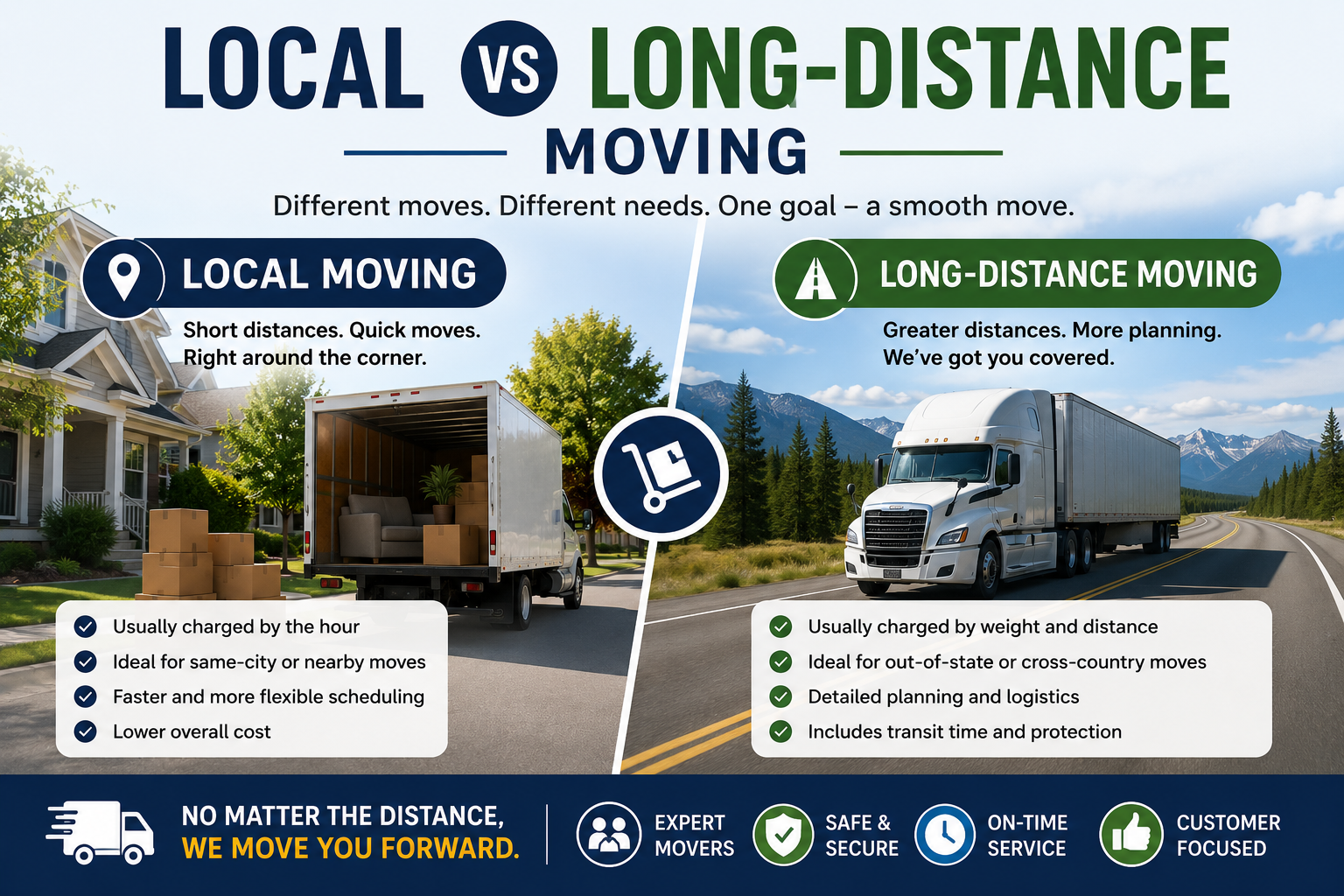
Why does this matter so much? Because the entire pricing structure changes. Local moves in Winnipeg are almost always billed by the hour. Long-distance moves are billed by weight, distance, or a combination of both. Two completely different systems. Two completely different ways to budget.
Understanding this upfront saves families hundreds — sometimes thousands — of dollars in surprises.
How Are Local Moving Costs Calculated in Winnipeg?
Local moving services in Winnipeg work on an hourly rate. You pay for the time the crew is working, from when they show up at your door to when the last box is placed in your new home.
Several things affect how many hours your local move takes:
The size of your home. A one-bedroom apartment in the Exchange District moves much faster than a four-bedroom house in Linden Woods. Every extra room adds time — usually 45 minutes to over an hour per room once you count the loading, transport, and unloading.
How prepared you are. Movers who arrive to find nothing packed lose time fast. Every hour of professional time spent packing boxes or wrapping furniture instead of moving it adds to your final bill.
Elevator or stair access. Buildings in Winnipeg’s downtown core and older neighbourhoods often have narrow stairwells or single elevators. That slows everything down.
Distance between your two addresses. Even within the city, moving from Sage Creek to Wolseley is a longer drive than moving between two streets in River Park South. That windshield time counts.
Parking and building access. If a moving truck can’t park close to the door, the crew carries everything farther. That adds up.
Most Winnipeg local moves land somewhere between two and eight hours depending on these factors. Getting a proper in-home estimate — rather than a quick quote over the phone — gives you a much more accurate picture. With local moving Winnipeg, Swift Mover offers walkthroughs so your quote reflects your actual home, not a generic guess.
How Are Long-Distance Moving Costs Calculated From Winnipeg?
Long-distance moves operate on a completely different model. Here, the two biggest cost drivers are weight and distance.
Movers weigh the truck before and after loading your belongings. That weight difference is your shipment weight, and it becomes the base of your bill. Then that number is multiplied by the distance in kilometres to your destination.
Moving from Winnipeg to Calgary? That’s roughly 1,300 kilometres. Winnipeg to Vancouver is closer to 2,300 kilometres. Winnipeg to Toronto is around 2,100 kilometres. Each of those distances, applied to the weight of a three-bedroom home’s worth of furniture, gives you a very different number.
Other long-distance costs to keep in mind:
Packing materials and services. Many families choose professional packing for long moves because their belongings are in transit longer and need more protection.
Storage in transit. If your new home isn’t ready when the truck arrives, your items go into storage. This is common in long-distance moves, and it adds cost.
Fuel surcharges. Longer routes mean higher fuel costs, and most moving companies include this as a line item.
Delivery windows. Long-distance moves rarely arrive on a single confirmed day. There’s usually a delivery window — sometimes several days wide. If you need a guaranteed delivery date, expect to pay extra for it.
Liability and valuation coverage. For a short local move, basic coverage is often fine. When your dining table travels 2,000 kilometres, you want to think harder about full replacement value coverage. The Government of Canada’s Consumer Affairs resources outline your rights around carrier liability — it’s worth reading before you sign anything.
For families heading out of Manitoba, long-distance moving Winnipeg through Swift Mover includes binding estimates so you know what you’re paying before the truck leaves your driveway.
What Factors Make Moving Costs Go Up — Regardless of Distance?
Some costs catch people off guard whether they’re moving three kilometres or three provinces over. Here are the ones that matter most:
Specialty items. Pianos, gun safes, large antiques, and oversized furniture require special equipment and handling. These are always quoted separately.
Time of year. May through August is peak moving season in Winnipeg. Crews are busier, availability is tighter, and rates are often higher. If you can move in late September, October, or even February, you’ll likely have more flexibility — and sometimes better rates.
Last-minute bookings. Planning your move two to four weeks ahead gives you the best shot at a good crew and a realistic timeline. Booking within a few days of your move date limits your options significantly.
Packing service add-ons. Full-pack services where the crew packs every item in your home cost more than partial-pack (where you pack most things yourself and the crew handles fragile items). Both are options. Choose based on your time and budget.
Disassembly and reassembly. Beds, large bookshelves, sectional sofas — these often need to come apart to get through doors or onto a truck. If you don’t want to do this yourself, factor in the time and labour cost.
What Should You Do Before Booking Any Moving Service in Winnipeg?
Getting this right comes down to a few clear steps.
Step one: Know what kind of move you have. Staying in Winnipeg or the surrounding area? Local. Leaving the city for another city or province? Long-distance. Confirm this before you talk to anyone.
Step two: Take inventory. Go room by room and note what’s coming and what you’re getting rid of. The more accurate your list, the more accurate your estimate.
Step three: Get a written estimate. Never rely on a verbal quote for a move of any size. Ask for a written, itemized estimate that includes labour, fuel, any surcharges, and what happens if the job takes longer than expected.
Step four: Check the company’s credentials. In Canada, moving companies operating interprovincially must be registered. The Canadian Transportation Agency (cta-otc.gc.ca) maintains carrier information. For local moves within Manitoba, look for companies with a physical Winnipeg address, real reviews, and clear cancellation policies.
Step five: Book at least two to four weeks out. Especially in summer. The best crews fill up fast.
Why Local Knowledge Matters in Winnipeg Moving
Winnipeg has its own rhythms. Winters are genuinely brutal, and a moving crew that’s never navigated an icy River Avenue or a narrow back lane in the North End will cost you time and stress. Summer construction on Bishop Grandin or McGillivray can add 30 minutes to a trip that should take 10.
Swift Mover operates out of Winnipeg. Their crews know the city’s layouts, the buildings with the tricky loading docks, the neighbourhoods where parking is a genuine challenge, and how to handle Manitoba winters without damaging your floors or your belongings.
That local knowledge — the kind you only get from actually working in a city for years — is worth more than a low hourly rate from a company that treats Winnipeg the same as any other stop on a cross-country route.
Conclusion
Local moves in Winnipeg cost based on time. Keep the crew moving efficiently, be packed and ready, and your costs stay predictable.
Long-distance moves cost based on weight and distance. Declutter before you pack, understand what’s in your estimate, and protect yourself with the right valuation coverage.
Both types of moves have hidden costs if you’re not watching for them. Specialty items, time of year, building access, and how prepared you are on moving day — these things move the needle in either direction.
The families who move without stress are the ones who ask the right questions early, get written estimates, book in advance, and work with a crew that actually knows what they’re doing in their city.
That’s the whole comparison. No mystery. No fine print. Just a clear look at how moving costs actually work in Winnipeg so you can make a decision that protects your budget and your family’s peace of mind.
Frequently Asked Questions
Is it cheaper to move locally or long-distance in Winnipeg?
Local moves are almost always less expensive in total dollars because the distance and transit time are shorter. But on a per-hour basis, the rates can be similar. Long-distance costs scale quickly with weight and distance, so a large family home moved across provinces can cost several times more than a local move of the same home.
How far can I move and still be considered a local move in Winnipeg?
Generally, moves within Winnipeg or within roughly 50 to 80 kilometres of the city are treated as local. Anything beyond that — including moves to Brandon, Portage la Prairie, or out of Manitoba entirely — is typically quoted as long-distance. Confirm this with your moving company before booking.
Do I need moving insurance for a local move in Winnipeg?
Basic carrier liability is standard in most moving contracts, but it usually only covers a fraction of your belongings’ real value. For a local move, you may decide basic coverage is sufficient. For a long-distance move where items are in transit longer, full replacement value coverage is worth the extra cost.
What time of year is cheapest to move in Winnipeg?
Fall and winter — particularly September through March — tend to have more availability and sometimes lower rates than the busy summer season. The trade-off in winter is Winnipeg weather, so plan for it. Spring (April to May) can also work well if you book ahead.
How do I verify a moving company is legitimate in Winnipeg?
For interprovincial long-distance moves, check that the company is registered with the Canadian Transportation Agency at cta-otc.gc.ca. For local moves within Manitoba, look for a verifiable Winnipeg address, Google reviews with real responses, and a written contract before you confirm anything.