

Moving your company to a new address is stressful, and most owners want one simple answer: what do Office Relocation Services in Winnipeg actually cover, and will they keep my business running while the move happens? In short, good movers handle packing, IT equipment, furniture, transport, and setup, so your team can work almost normally on both ends. Here is what to expect, what usually goes wrong, and how to plan it right the first time. What Do Office Relocation Services in Winnipeg Actually Include? Most people picture a moving truck. That is only a small piece of it. Office Relocation Services in Winnipeg usually cover far more ground than a home move because businesses cannot afford downtime. A proper service includes: Packing and labeling desks, files, and electronics Safe handling of computers, servers, and monitors Furniture disassembly and reassembly Transport with insured, trained crews Setup at the new site so staff can sit down and work Some companies also offer weekend or after-hours moves, so employees walk into a fully working office on Monday morning instead of a pile of boxes. Why Do Winnipeg Businesses Struggle With Office Moves? Here is the honest part. Office moves fail not because of trucks or boxes, but because of poor planning around people and time. Owners often underestimate how long packing takes. Staff get pulled off real work to pack their own desks. IT equipment gets unplugged without labels, and nobody remembers which cable goes where. Then the new space is not ready, so furniture sits in a hallway for two days. We get it. You are trying to run a business, not manage a move. That stress is normal, and it is exactly why Office Relocation Services in Winnipeg exist. A team that moves offices every week already knows the mistakes to avoid, because they have seen them play out dozens of times. The fix is simple: bring in people who treat the move as the job, not as an extra task squeezed between meetings. How Do Office Relocation Services in Winnipeg Reduce Downtime? Downtime is the real cost of a bad move. Every hour your team cannot work is an hour you are paying for nothing. Experienced Office Relocation Services in Winnipeg reduce downtime by working in phases instead of one chaotic day. They pack non-essential items first, weeks ahead. They move IT racks and phone systems last, right before staff arrive, so systems stay live as long as possible. They also label everything by department, so unpacking at the new site does not turn into a treasure hunt. For businesses that only need help within the city, a local moving winnipeg crew can often complete the whole job in a single weekend, which keeps disruption to a minimum. What Pain Points Do Growing Companies Face During a Move? Growing businesses face a different problem than small startups. You have more equipment, more staff, and more furniture, but the same tight deadline to be operational. Common pain points include: Servers and shared printers that cannot go offline for long Meeting rooms full of screens and cables with no clear owner Staff worried about losing files or personal items during transit Landlords giving a short window to vacate the old space Every one of these is fixable with a plan. The solution is not more stress on your team, it is handing the physical work to a crew trained for commercial moving winnipeg businesses rely on, while your staff focuses on clients and daily tasks. This is where professional Office Relocation Services in Winnipeg earn their value, since they handle the equipment and timing questions you do not have time to solve on your own. What Is the Simple Step Process Behind a Smooth Office Move? A move does not need to be complicated. Most Office Relocation Services in Winnipeg follow the same basic process, and knowing the steps ahead of time helps you spot a company that actually has a plan. Here is the process that works, broken into plain steps. Walkthrough and plan – A mover visits or reviews your space and builds a timeline around your business hours. Pack early, pack smart – Non-urgent items get packed and labeled by room, days or weeks before the move date. IT and equipment handling – Computers, servers, and phones are disconnected, protected, and tracked so nothing is lost. Moving day – Furniture and boxes are loaded, transported, and delivered to the new site with a checklist. Setup and unpack – Desks, chairs, and equipment are placed where your team needs them, ready to use. Businesses that want the whole job handled from start to finish, including furniture and desk setup, usually look for full office moving winnipeg support rather than piecing it together themselves. Why Trust a Local Winnipeg Team With Your Office Move? Local knowledge matters more than people expect, and it is one of the biggest reasons businesses choose local Office Relocation Services in Winnipeg over a national chain. A Winnipeg-based crew knows the tight loading docks downtown, the elevator booking rules in older buildings, and which routes get slow during rush hour on Portage Avenue or near the Perimeter Highway. They also understand winter. Ice on a loading ramp in January is a real safety issue, and local crews plan around it instead of learning the hard way. There is also a paperwork side many owners forget. When your business address changes, you need to update it with the Canada Revenue Agency so your tax records, GST account, and payroll stay accurate. You can find the steps for this directly through the official CRA business address update page, which is worth doing in the same week as your physical move so nothing slips through the cracks. Choosing a local team also means faster response if something changes last minute, like a delayed lease handover or a building access issue. You are not waiting on a call center hours away. Conclusion Moving a business is never just

How to Move Heavy Furniture Without Damage?
Your couch scrapes the doorframe. Your dresser leaves a scratch on the hardwood. Your back hurts before the truck is even loaded. If you are searching for how to move heavy furniture without damage, you already know the stress is real, and the fear of ruining a wall, a floor, or a family heirloom is even worse. The good news is that with the right prep, tools, and order of steps, most damage is completely avoidable, even for a full house move in a Canadian winter or a tight apartment hallway. This guide walks through the real, tested answer to how to move heavy furniture without damage, using steps that work in small apartments, walk-up houses, and everything in between. What Actually Counts as “Heavy Furniture”? Think sofas, sectionals, wardrobes, dressers, dining tables, bookshelves, and appliances like fridges or washers. Anything that needs two people, a dolly, or straps to shift safely falls into this category. Knowing this helps you plan tools and manpower before moving day instead of guessing halfway through. Why Does Moving Furniture Cause So Much Damage? If you want to move heavy furniture without damage, start by understanding why damage happens in the first place. Here is the honest truth. Most damage does not happen because people are careless. It happens because they rush. A tight staircase, a narrow hallway, or an awkward angle at the door catches people off guard, and that is when walls get dented and furniture gets scratched. If you have ever felt that stomach-drop moment when a couch corner catches drywall, you are not alone. Almost every Canadian homeowner has a story like this. The fix is simple once you understand it. Learning how to move heavy furniture without damage is really about slowing down, measuring first, and protecting the pieces that matter before you ever lift a single item. How Do You Move Heavy Furniture Without Damage? This is the part everyone wants answered fast, so here it is in plain language. Measure doorways, hallways, and staircases before moving day Disassemble what you can, like table legs, bed frames, and shelving units Use moving blankets, not bedsheets, to wrap corners and edges Slide furniture on sliders or old towels instead of dragging it Lift with your legs, not your back, and always bend knees together Keep floors covered with cardboard or moving mats along the main path None of this needs fancy equipment. Most of it costs very little and saves you from expensive repairs later. What Tools Actually Prevent Damage? Choosing the right tools is half the battle when you want to know how to move heavy furniture without damage. You do not need a warehouse of gear. A furniture dolly, moving straps, corner protectors, and stretch wrap cover almost every situation. Straps are especially useful for stairs because they let two people carry weight on their shoulders instead of their arms, which reduces the chance of dropping something heavy mid-flight. Getting these tools ready ahead of time is one of the easiest ways to answer how to move heavy furniture without damage on the actual day. Is It Safe to Move Heavy Furniture Alone? Honestly, it depends on the piece. A dresser or small bookshelf, maybe. A sectional sofa or a fridge, no. Moving alone is one of the biggest causes of injury and property damage combined, because one person cannot control the balance or angle of a heavy object on their own. If a piece feels awkward to lift by yourself, that feeling is your body telling you to wait for help. Understanding how to move heavy furniture without damage also means understanding the hidden costs people forget about until moving day arrives. The Pain Point Nobody Talks About: Damaged Rental Deposits If you rent, this one hits hard. A single wall scuff or a dented door frame can cost you part of your damage deposit. This is one of the quiet financial risks of moving day that people forget until it is too late. The solution is easy though. Protect doorframes with old towels or moving blankets taped gently in place, and always carry furniture upright through tight spaces instead of tilting it toward the wall. The Pain Point Nobody Talks About: Back and Joint Injuries Furniture does not just damage floors and walls, it damages bodies too. Lower back strain is one of the most common injuries during a move, and it usually happens because someone twists while lifting instead of turning their whole body. Slow down, keep the item close to your torso, and always communicate with your lifting partner before taking a step. This small habit alone helps you move heavy furniture without damage to your body, not just your belongings. Simple Step-by-Step Process to Move Heavy Furniture Without Damage Here is the process broken down so it feels manageable, not overwhelming. Plan the path first. Walk the route from the furniture to the truck and clear anything in the way. Protect the furniture. Wrap corners and legs in moving blankets and secure with stretch wrap. Protect your home. Lay down floor runners or cardboard along doorways and hallways. Disassemble where possible. Remove legs, shelves, and drawers to reduce weight and width. Use the right equipment. Dollies for flat surfaces, straps for stairs, sliders for hardwood or tile. Lift together. Count out loud, lift with your legs, and move slowly through tight turns. Load the truck smart. Heaviest items go in first, against the wall, secured with straps so nothing shifts in transit. This is genuinely how to move heavy furniture without damage in almost every home, from a small apartment to a full family house. Why Local Experience Matters When Learning How to Move Heavy Furniture Without Damage Winnipeg homes have their own quirks. Older character homes often have narrow staircases and low doorframes, while newer builds have tight condo elevators and strict building rules about moving hours. A crew that regularly handles furniture moving Winnipeg jobs already knows these layout

Top 10 Mistakes to Avoid When Moving in Winnipeg
It’s 7 PM the night before moving day, and a Winnipeg family is staring at a pile of unlabeled boxes, a half-loaded truck, and a toddler who refuses to nap. Sound familiar? Every spring and fall, hundreds of local families learn the hard way which moving mistakes cost the most time, money, and patience. The Top 10 Mistakes to Avoid When Moving in Winnipeg almost always come down to the same root causes: poor timing, weak planning, and underestimating our weather. The good news is that every single one of these mistakes is avoidable once you know what to watch for. What Are the Most Common Mistakes Winnipeg Families Make When Moving? Moving across the city, or even just across the Perimeter Highway, brings out the same handful of problems again and again. Narrow back lanes in older neighbourhoods like Wolseley, tight parking near Osborne Village, and our famous freeze-thaw cycles all add pressure that families in flatter, milder cities rarely deal with. Leaving everything until the last weekend. It feels like there’s plenty of time until there suddenly isn’t. Most families underestimate how long packing actually takes once you account for work, kids, and life getting in the way. Start sorting room by room at least three weeks before your move date, even if it’s just an hour a night. Skipping a written inventory. Boxes disappear, furniture gets left behind, and nobody remembers which box has the kettle. A simple numbered list, even on paper, saves hours of searching later and helps you spot anything missing once you’re unpacked. Choosing movers based on price alone. A rock-bottom quote can turn into a stressful day if the crew is understaffed or unfamiliar with your building’s rules. Ask how many movers will show up and how they handle large or awkward items before you book anything. Packing fragile items with whatever box is on hand. Thin boxes and newspaper feel fine until something breaks on the drive over. Dishes, glassware, and electronics need proper padding and sturdy boxes, not leftover liquor store containers. Forgetting Winnipeg’s weather entirely. A move that looks easy on paper can turn rough fast if you’re carrying boxes through October slush or a January cold snap. Always check the forecast a few days out and have a backup plan if conditions turn. Getting ahead of these five issues already puts you well ahead of most of the Top 10 Mistakes to Avoid When Moving in Winnipeg, and the next batch is just as easy to fix once you know they’re coming. What Other Mistakes Catch People Off Guard During a Winnipeg Move? These next few are the ones people rarely think about until they’re already happening on moving day. Not measuring doorways, hallways, and stairwells. That couch fit through the door once, but the new place might have a tighter turn or a lower ceiling in the stairwell. Measure your biggest pieces and the openings before move day, not during it. Underestimating travel time across the city. Bishop Grandin, the Disraeli, and downtown construction can turn a quick drive into a long wait. Build extra time into your schedule, especially if you’re moving during rush hour or a long weekend. Forgetting to update your address before move day. Bills, bank cards, and important mail can end up at your old address for weeks if you wait too long. Canada Post’s mail forwarding service is a simple way to make sure nothing important slips through the cracks while you settle in. Not protecting floors and walls in character homes. Older homes in River Heights or Crescentwood often have original hardwood and tighter staircases. Hardwood scratches and wall dings happen fast without floor runners or corner guards in place. Trying to handle everything alone instead of asking for help. Pride costs more than people expect, both in sore backs and in broken items. Bringing in experienced packing and moving support for even part of the job often saves an entire weekend instead of costing one. Together, these ten issues make up the most common Top 10 Mistakes to Avoid When Moving in Winnipeg families run into, year after year, no matter which neighbourhood they’re leaving or heading to. How Can You Avoid the Top 10 Mistakes to Avoid When Moving in Winnipeg in Four Simple Steps? Once you know the Top 10 Mistakes to Avoid When Moving in Winnipeg, the fix comes down to a short, repeatable process. Step 1: Start three weeks early. Sort one room at a time. Donate or toss anything you haven’t touched in a year. Step 2: Build a simple inventory. Number your boxes and keep a short list of what’s inside each one. It takes ten minutes and saves hours later. Step 3: Update your address everywhere that matters. Set up mail forwarding through Canada Post, then update your driver’s licence, banks, and any subscriptions tied to your old address. Step 4: Build in a weather buffer. Check the forecast, plan for slower roads, and have gloves or boot trays ready depending on the season. Why Do Winnipeg Families Trust Local Moving Knowledge? Anyone can lift boxes. Knowing this city is a different skill. Local crews understand which downtown buildings require elevator bookings, which condo boards have strict move-in windows, and which older homes in Wolseley or St. Boniface have narrow staircases that need extra care. That local knowledge also covers the practical stuff: which streets turn into ice rinks in January, where parking enforcement is strict near Osborne Village, and how to plan a move around a Jets game or a long weekend without getting stuck in traffic. Families across Winnipeg keep coming back to movers who know these small details, because they’re the difference between a smooth day and a stressful one. That’s also why understanding the Top 10 Mistakes to Avoid When Moving in Winnipeg matters just as much as hiring the right help. Local knowledge and good planning work best together. Make Your Next Winnipeg Move Mistake-Free Moving
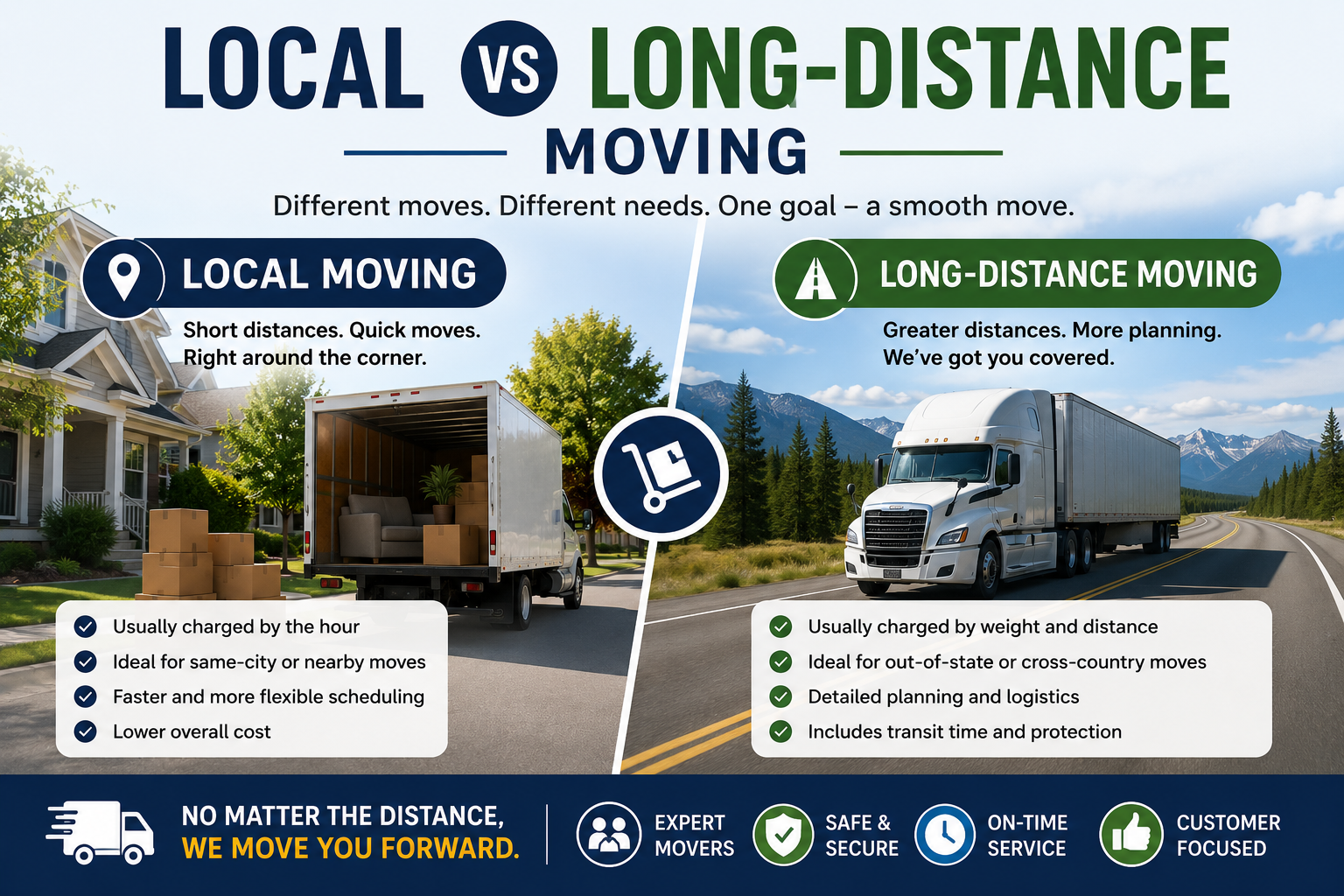
Local vs Long-Distance Moving Costs in Winnipeg
Last spring, a family in St. Vital started packing for what they thought would be a simple move across Winnipeg. Two weeks later, they were staring at a bill that was almost double what they expected — because nobody told them the difference between how local moves and long-distance moves are actually priced. If you’re planning a move anywhere in or out of Winnipeg, this guide is written so that never happens to you. What Is the Difference Between a Local and Long-Distance Move in Winnipeg? This is the question most people forget to ask before they book anything. In Canada, a local move generally means you’re staying within the same city or within roughly 50 to 80 kilometres. So moving from Transcona to River Heights? Local. Moving from Winnipeg to Brandon, or from Winnipeg to Toronto? That’s long-distance — sometimes called an interprovincial or out-of-province move if you’re crossing a provincial boundary. Why does this matter so much? Because the entire pricing structure changes. Local moves in Winnipeg are almost always billed by the hour. Long-distance moves are billed by weight, distance, or a combination of both. Two completely different systems. Two completely different ways to budget. Understanding this upfront saves families hundreds — sometimes thousands — of dollars in surprises. How Are Local Moving Costs Calculated in Winnipeg? Local moving services in Winnipeg work on an hourly rate. You pay for the time the crew is working, from when they show up at your door to when the last box is placed in your new home. Several things affect how many hours your local move takes: The size of your home. A one-bedroom apartment in the Exchange District moves much faster than a four-bedroom house in Linden Woods. Every extra room adds time — usually 45 minutes to over an hour per room once you count the loading, transport, and unloading. How prepared you are. Movers who arrive to find nothing packed lose time fast. Every hour of professional time spent packing boxes or wrapping furniture instead of moving it adds to your final bill. Elevator or stair access. Buildings in Winnipeg’s downtown core and older neighbourhoods often have narrow stairwells or single elevators. That slows everything down. Distance between your two addresses. Even within the city, moving from Sage Creek to Wolseley is a longer drive than moving between two streets in River Park South. That windshield time counts. Parking and building access. If a moving truck can’t park close to the door, the crew carries everything farther. That adds up. Most Winnipeg local moves land somewhere between two and eight hours depending on these factors. Getting a proper in-home estimate — rather than a quick quote over the phone — gives you a much more accurate picture. With local moving Winnipeg, Swift Mover offers walkthroughs so your quote reflects your actual home, not a generic guess. How Are Long-Distance Moving Costs Calculated From Winnipeg? Long-distance moves operate on a completely different model. Here, the two biggest cost drivers are weight and distance. Movers weigh the truck before and after loading your belongings. That weight difference is your shipment weight, and it becomes the base of your bill. Then that number is multiplied by the distance in kilometres to your destination. Moving from Winnipeg to Calgary? That’s roughly 1,300 kilometres. Winnipeg to Vancouver is closer to 2,300 kilometres. Winnipeg to Toronto is around 2,100 kilometres. Each of those distances, applied to the weight of a three-bedroom home’s worth of furniture, gives you a very different number. Other long-distance costs to keep in mind: Packing materials and services. Many families choose professional packing for long moves because their belongings are in transit longer and need more protection. Storage in transit. If your new home isn’t ready when the truck arrives, your items go into storage. This is common in long-distance moves, and it adds cost. Fuel surcharges. Longer routes mean higher fuel costs, and most moving companies include this as a line item. Delivery windows. Long-distance moves rarely arrive on a single confirmed day. There’s usually a delivery window — sometimes several days wide. If you need a guaranteed delivery date, expect to pay extra for it. Liability and valuation coverage. For a short local move, basic coverage is often fine. When your dining table travels 2,000 kilometres, you want to think harder about full replacement value coverage. The Government of Canada’s Consumer Affairs resources outline your rights around carrier liability — it’s worth reading before you sign anything. For families heading out of Manitoba, long-distance moving Winnipeg through Swift Mover includes binding estimates so you know what you’re paying before the truck leaves your driveway. What Factors Make Moving Costs Go Up — Regardless of Distance? Some costs catch people off guard whether they’re moving three kilometres or three provinces over. Here are the ones that matter most: Specialty items. Pianos, gun safes, large antiques, and oversized furniture require special equipment and handling. These are always quoted separately. Time of year. May through August is peak moving season in Winnipeg. Crews are busier, availability is tighter, and rates are often higher. If you can move in late September, October, or even February, you’ll likely have more flexibility — and sometimes better rates. Last-minute bookings. Planning your move two to four weeks ahead gives you the best shot at a good crew and a realistic timeline. Booking within a few days of your move date limits your options significantly. Packing service add-ons. Full-pack services where the crew packs every item in your home cost more than partial-pack (where you pack most things yourself and the crew handles fragile items). Both are options. Choose based on your time and budget. Disassembly and reassembly. Beds, large bookshelves, sectional sofas — these often need to come apart to get through doors or onto a truck. If you don’t want to do this yourself, factor in the time and labour cost. What Should You Do Before Booking Any Moving Service in

Commercial Moving Checklist for Winnipeg Businesses: What Nobody Tells You Before Moving Day
You booked the movers. You told your team. You even ordered new business cards with the new address. Then moving day arrived — and absolute chaos broke out. The server room wasn’t labelled. Half the staff showed up to the old location. And someone left the boardroom chairs behind. Sound familiar? This commercial moving checklist for Winnipeg businesses exists because of exactly these moments. Whether you’re relocating a small downtown office or moving an entire warehouse operation across the city, the difference between a smooth move and a costly disaster comes down to one thing — preparation. What Should a Commercial Moving Checklist for Winnipeg Businesses Include? A solid commercial moving checklist for Winnipeg businesses covers everything from your first planning meeting to your first full day operating at the new location. It’s not just about packing boxes. It’s about protecting your business continuity, your equipment, your staff, and your client relationships — all at the same time. Here’s what that looks like in practice. How Far in Advance Should Winnipeg Businesses Start Planning a Commercial Move? Start at least 60 to 90 days out. If you’re a larger operation — a medical office, a multi-floor business, or a company with specialized equipment — give yourself four to six months minimum. Winnipeg businesses often underestimate lead time. Permits, elevator bookings in commercial buildings, IT vendor scheduling, and seasonal weather windows all need coordination. A commercial moving checklist for Winnipeg businesses that starts 90 days early gives you room to solve problems before they become emergencies. Here’s the phase-by-phase breakdown: 90 Days Out Assign a move coordinator inside your team. One person needs to own this project. Form a short checklist of every department’s unique needs — IT, reception, storage, kitchen, server room. Start getting quotes from commercial moving companies that specialize in business relocations, not just residential moves. Also register or update your business address with the Canada Revenue Agency at that point. CRA keeps your GST/HST account, payroll, and corporate accounts tied to your registered address — updating it early avoids delays with tax filings and government mail. You can update your business address directly through the CRA My Business Account portal. 60 Days Out Notify your landlord in writing — check your lease for required notice periods. Coordinate with your new building’s management about elevator access, loading dock hours, and parking availability for moving trucks. Book your office moving Winnipeg date. Good commercial moving companies in Winnipeg fill up fast, especially between May and September. Don’t assume you can book a week before. Create a master floor plan of your new space. Where does each department sit? Where does the server rack go? Where are the printer stations? Having this answered before moving day eliminates chaos on the day itself. 30 Days Out Send a formal change-of-address notice to every vendor, supplier, client, and service provider. Canada Post offers a business mail forwarding service — set that up as a safety net, but don’t rely on it as your main communication plan. Update your Google Business Profile, website, social media, and any industry directories with your new Winnipeg address. Audit your inventory. This is the moment to get rid of equipment that’s outdated, furniture that doesn’t fit the new space, or supplies that have been sitting in a storage room for two years. Donate, sell, or responsibly recycle — the City of Winnipeg has disposal resources through Winnipeg’s waste and recycling services that businesses can access. Two Weeks Out Start labelling everything — not just with a room name, but with a specific location. “Server Room — Rack A” is more useful than “IT.” Color-code by department if that helps your movers. Confirm all move-day logistics: truck arrival time, staff roles, who has keys to the new building, who handles the old building lockup. Brief your team. They need to know what’s happening, what’s expected of them on move day, and what the first week at the new location looks like. Move Day Have your move coordinator on-site at both locations — or split that role between two trusted people. Walk through both spaces with Swift Mover’s crew lead before anything gets loaded. Point out fragile equipment, items requiring special handling, and anything that must be set up first at the new location. Take timestamped photos of equipment, furniture, and each room before loading — both for insurance purposes and to catch anything that may have been damaged in transit. Do not sign off on the move completion until you’ve done a full walkthrough of the new space and confirmed nothing is missing or damaged. First Week at the New Location Test all IT systems on day one — internet, phones, POS systems, security cameras. Issues discovered on day one are fixable. Issues discovered on day five cost you client trust. Update your address with Service Canada if you have employees — this affects Records of Employment and payroll records. You can make changes through My Business Account on Canada.ca. Communicate the move to your clients one more time. A short, direct email goes a long way. “We’ve moved. Here’s the new address. We’re fully operational.” That’s all it needs to say. What Makes Commercial Moving in Winnipeg Different from Residential Moving? Commercial moves involve stakeholders that residential moves don’t — employees, clients, vendors, and building management on both ends. They also involve equipment that’s expensive, fragile, or both. A single server rack move done wrong can cost more in data loss than the entire move cost. Winnipeg’s winters add another layer of complexity. If your move window falls between November and March, factor in cold-weather risks for electronics, vehicle delays, and the physical challenge of moving heavy equipment on icy loading docks. A commercial moving checklist for Winnipeg businesses written for our specific climate should include a weather contingency plan. What happens if a major snowstorm hits on move day? Have a backup date identified with your movers before you need it. How Do You Keep

How to Safely Dispose of Appliances in Winnipeg
Your old fridge stopped working last Tuesday. Now it’s sitting in your kitchen, taking up space, and nobody knows what to do with it. You can’t just drag it to the curb on garbage day. You can’t leave it in the alley. And calling the city feels like a whole project. If you’ve ever stood in your kitchen staring at a dead appliance wondering what comes next — this guide is written for you. Here’s everything Winnipeg families need to know about how to safely dispose of appliances in Winnipeg, without the stress, fines, or environmental guilt. Why Can’t You Just Put an Old Appliance on the Curb in Winnipeg? A lot of people assume large appliance pickup works like regular garbage. It doesn’t. The City of Winnipeg does not collect appliances as part of standard curbside waste pickup. Large items like refrigerators, stoves, washing machines, and dryers contain materials that need special handling — refrigerants, compressor oils, metals, and plastics that can’t go to a regular landfill. Leaving an appliance on the curb without authorization can result in a bylaw violation. More than that, it causes real environmental harm. Refrigerants, for example, are greenhouse gases. One improperly dumped fridge can release enough refrigerant to cause lasting damage to local air quality. The good news? Winnipeg has solid options for doing this the right way. What Does the City of Winnipeg Actually Offer for Appliance Disposal? The City of Winnipeg operates four Residential Waste Disposal Facilities (RWDFs) where residents can drop off large appliances free of charge with proof of Winnipeg residency. These facilities accept: Refrigerators and freezers Stoves and ovens Washing machines and dryers Dishwashers Air conditioners You can find facility locations, hours, and acceptable items on the City of Winnipeg Waste Reduction page. Hours change seasonally, so checking before you go saves a wasted trip. There’s one important requirement: all appliances with refrigerants must be brought in with the refrigerant intact. Don’t try to drain or vent a refrigerator yourself. That’s illegal under federal regulations and genuinely dangerous. If the refrigerant has already been tampered with, the facility may refuse the appliance. What Happens to Appliances After You Drop Them Off? When you drop an appliance at a Winnipeg disposal facility, it goes through a regulated process. Refrigerants are recovered by certified technicians following standards set under the Canadian Environmental Protection Act (CEPA). Metals are separated and sent for recycling. Components that can be reused are pulled out. What’s left — a much smaller amount — goes to landfill. This process keeps hazardous materials out of the soil and water. It also recovers valuable materials that would otherwise be wasted. Knowing this makes it easier to follow the rules. You’re not just following regulations — you’re actually protecting the Red River watershed and the broader Prairie ecosystem that Winnipeg sits within. How to Safely Dispose of Appliances in Winnipeg — Step by Step Here’s a clean process that works for most Winnipeg households. Step 1: Identify what you have. Is it a refrigerator, freezer, or air conditioner? These contain refrigerants and need special care. Everything else — stoves, washers, dryers — is simpler but still not curbside material. Step 2: Check if it still works. A working appliance can be donated. Winnipeg organizations like Habitat for Humanity ReStore accept working appliances. This keeps usable items out of the waste stream entirely. Step 3: Book a pickup or plan your drop-off. You have two paths — haul it yourself to a City RWDF, or hire a professional appliance removal service. If the appliance is heavy, awkward, or involves stairs and tight hallways, a professional crew makes a lot more sense than risking injury or damaging your floors. Step 4: Prepare the appliance. Empty the fridge, disconnect it from power, and defrost it if needed. Remove any food, shelving, and loose parts. Don’t try to remove doors from fridges — the facility handles that. Step 5: Complete the disposal. Whether you drop it off yourself or arrange pickup, make sure you get confirmation that the appliance will be processed correctly. A reputable service provides documentation or at minimum clear communication about where your appliance ends up. Should You Hire a Professional Appliance Removal Service in Winnipeg? For a lot of households, this is the easier path — and honestly, the smarter one. Moving a washer down a narrow basement staircase by yourself is how people end up in the ER. Same with refrigerators — they’re heavy, awkward, and oddly shaped. If you’re also in the middle of a renovation, a move, or dealing with a property cleanout, managing appliance removal on top of everything else is just one thing too many. Professional appliance removal Winnipeg services handle the heavy lifting, transport, and proper disposal — so you don’t have to coordinate three separate steps yourself. When you’re already working with moving services for a home transition, bundling appliance removal into the same booking is practical. Swift Movers, for example, offers appliance removal as part of their moving services in Winnipeg, which means one crew, one schedule, one less thing to manage during what’s already a stressful time. The key thing to look for in any removal service: confirm they dispose of appliances through approved channels. Ask where the appliance goes. A reputable company can answer that clearly. Can You Donate or Sell an Old Appliance in Winnipeg Instead? Absolutely — if it works. Winnipeg has a strong secondhand market. Working appliances sell quickly on Facebook Marketplace and Kijiji. If you’d rather donate, Habitat for Humanity ReStore on Keewatin Street accepts working appliances and uses the proceeds for affordable housing builds. Some appliance retailers in Winnipeg also offer haul-away programs when you purchase a new unit. Ask at the time of purchase — it’s often free or low-cost and they handle the disposal for you. This option only works for functional appliances. If it’s broken beyond repair, the donation route isn’t available, and you’ll need the disposal path instead. What

Best Neighbourhoods to Move to in Winnipeg in 2026
You’ve got boxes half-packed, a school transfer form on the counter, and your partner asking “are we making the right call?” That pressure is real. Picking the wrong neighbourhood in Winnipeg means your kids end up at a school you didn’t want, your commute doubles, and you’re stuck for years regretting the decision. The best neighbourhoods to move to in Winnipeg in 2026 aren’t the ones with the flashiest listings — they’re the ones that actually fit how your family lives. Here’s the honest breakdown. What Makes a Winnipeg Neighbourhood Worth Moving to in 2026? Winnipeg has grown faster than most people expected. New transit corridors, school upgrades, and infrastructure work have quietly shifted which areas offer real value. The best neighbourhoods to move to in Winnipeg in 2026 share a few things: walkable amenities, solid schools, reasonable commute times, and that feeling of actually knowing your neighbours. Before you sign anything, check how a neighbourhood scores on the Statistics Canada Community Profiles — it gives you income distribution, population density, and age breakdown that no real estate listing will tell you. Which Winnipeg Neighbourhood Is Best for Families with Young Kids? Waverley West keeps coming up, and for good reason. This southwest neighbourhood has seen the most new school construction in the city over the last five years. Parents moving here aren’t gambling — they’re walking their kids to schools that were built in the last decade, with proper facilities. The roads connect well to Kenaston Boulevard, grocery stores are within a short drive, and the housing stock ranges from newer townhomes to detached houses with actual yards. If you have kids under ten and you’re relocating to Winnipeg, Waverley West deserves serious attention. One thing people miss: the neighbourhood is still expanding. That means new parks, new playgrounds, and more families landing there every month — community builds quickly when everyone’s new. Is River Heights Still Worth It in 2026? Yes, but know what you’re buying. River Heights is one of the best neighbourhoods to move to in Winnipeg in 2026 if you want character, mature trees, and walkability. The homes are older, which means charm and quirks in equal measure. You’ll get hardwood floors and big lots. You’ll also get a furnace that might need attention. The area sits close to Corydon Avenue — coffee shops, restaurants, independent stores. It doesn’t feel suburban. If you’re a young professional or a couple without kids, this neighbourhood fits differently than Waverley West does. Renters have good options here too. The mix of housing types keeps the area from feeling homogenous. What About Transcona for Budget-Conscious Movers? Transcona sits in the east end and consistently offers lower entry prices than the city’s more talked-about areas. That makes it one of the best neighbourhoods to move to in Winnipeg in 2026 for first-time buyers or families stretching their budget. The community has a strong identity — people from Transcona tend to stay in Transcona. Local shops, community centres, and schools have loyal followings. It’s not trendy, but it’s solid. The tradeoff is commute time if you’re working downtown. Plan that into your decision. But if you work in the east end or from home, Transcona makes financial sense without sacrificing community feel. Is St. Vital a Safe Bet for 2026? St. Vital rarely gets the press it deserves. It sits in the southeast, borders the Red River, and has Southdale and Windsor Park folded into its broader area. The school options are strong, the streets feel established, and St. Vital Centre gives you practical shopping without needing to drive across the city. For families prioritizing stability over trendiness, St. Vital is one of the best neighbourhoods to move to in Winnipeg in 2026. The housing mix includes bungalows, split-levels, and newer builds depending on which pocket you land in. If you have elderly parents who might visit or eventually move nearby, the accessibility of the area — flat terrain, good bus routes, medical clinics — makes it thoughtful choice-making, not just convenient. What Is the Safest and Most Walkable Area Near Downtown Winnipeg? Osborne Village and Fort Rouge answer that question well. These two overlap in feel. Both sit close enough to downtown that car dependency drops significantly. Osborne Village especially has a density of services — pharmacy, gym, restaurants, transit — that lets residents genuinely go car-light. These are among the best neighbourhoods to move to in Winnipeg in 2026 for people who want urban living without full downtown density. Rents run higher here than in the suburbs, but you offset that with lower transportation costs. For newcomers to Canada settling in Winnipeg, this part of the city often becomes home first because services are accessible. The Government of Canada’s settlement services can help connect you with local supports as you get established. How Do You Actually Plan a Move to a New Winnipeg Neighbourhood? Planning matters more than most people admit until they’re in the middle of moving day chaos. Here’s a simple process that works: Step 1 — Visit before you commit. Drive or walk your target neighbourhood on a Tuesday morning and a Saturday afternoon. Different energy. Trust both. Step 2 — Check school boundaries directly. Winnipeg School Division and Louis Riel School Division both have boundary tools online. Don’t assume proximity means enrollment. Step 3 — Research the transit route. Winnipeg Transit’s online trip planner shows you real commute times from any address. Step 4 — Plan your moving logistics early. Winnipeg winters are not forgiving. If you’re moving between October and March, book your moving services well ahead. Icy driveways, packed elevators in condo buildings, and short daylight hours all add time. A local team that does packing and moving Winnipeg takes the physical load off so you can focus on the transition itself. Step 5 — Update your address with CRA and provincial services. Use My Account on the CRA website to update your address for tax purposes. Manitoba residents also need to

What to Do With Old Furniture Before You Move
Moving day is three weeks out. You walk through the living room and realize half the furniture either won’t fit in the new place, is held together by hope, or just doesn’t make sense to haul across the city. Sound familiar? Every Canadian family faces this exact moment before a move — that quiet panic when you realize you’ve got a decade’s worth of stuff to deal with, and no clear plan. Figuring out what to do with old furniture before you move is one of the most overlooked parts of the process, and it can either cost you time and money or save you a surprising amount of both. Why Does Old Furniture Become Such a Big Problem Before a Move? Most people don’t think about their furniture until the boxes are already packed. By then, the couch that seemed fine two years ago suddenly looks like it belongs at the curb. The problem is that moving services charge by weight, volume, and time. Every item you move unnecessarily adds to that cost. The other issue is space. Whether you’re moving into a smaller condo in Winnipeg or a new house across the province, not everything follows you. Dragging furniture that doesn’t belong in your next home creates clutter on day one — before you’ve even had a chance to settle in. Starting this process early, about four to six weeks out, makes a real difference. What to Do With Old Furniture Before You Move: A Simple Step-by-Step Plan Step 1: Sort Everything Into Three Groups Walk through your home with a notepad. Put every piece of furniture into one of three categories: Keep — it’s in good shape, it fits the new space, and you actually want it. Remove — it’s broken, worn out, or simply not coming with you. Decide later — you’re not sure yet. Give yourself a deadline of one week on these. Be honest. Sentimental attachment is real, but so is the cost of moving a dresser that falls apart when you open the drawer. Step 2: Measure Before You Commit Before you load anything onto the truck, measure your new space. This step saves Canadian families from one of the most common moving regrets — arriving at the new home with furniture that physically won’t fit through the door or into the room. Check door widths, hallway turns, and ceiling heights. If a sectional sofa won’t make it around a corner, it’s better to know now than at 9pm on moving day. Step 3: Sell What Still Has Value Good furniture sells. Facebook Marketplace, Kijiji, and local buy-and-sell groups across Manitoba and beyond are active every day. Price things fairly — a solid wood dining table can bring in two to three hundred dollars. A decent sectional, even an older one, moves quickly. List items at least three weeks before your move date. That gives buyers time to find you and arrange pickup. Anything not sold by moving week either gets donated or removed. Step 4: Donate to Local Organizations Many Canadian charities accept gently used furniture and put it directly into the hands of families who need it. Habitat for Humanity ReStores across the country accept sofas, chairs, tables, bed frames, and more. The Salvation Army and local shelters are also worth a call. The Government of Canada’s community services directory can help you locate donation programs near you. Some organizations offer free pickup, which is a real bonus when you’re already stretched thin. Donating also keeps furniture out of landfill, which aligns with provincial waste reduction goals across Canada. Step 5: Arrange Professional Furniture Removal for What’s Left After selling and donating, you’ll still have pieces that don’t go anywhere — the broken recliner, the water-damaged bookshelf, the mattress that nobody wants. This is where professional furniture removal Winnipeg services come in. Swift Mover handles the heavy lifting so you don’t have to wrestle bulky pieces down stairs or try to fit them into your car. Booking removal services early prevents a last-minute scramble. Getting this handled before moving day means you’re not tripping over junk while trying to pack. Step 6: Don’t Leave It for Moving Day This is where most people go wrong. They tell themselves they’ll “deal with it on the day.” Then moving day arrives, the truck is there, the crew is on the clock, and there’s a pile of stuff nobody knows what to do with. That confusion costs time — and money. Handle furniture decisions before the movers arrive. It makes the entire day cleaner, faster, and less stressful for everyone. How Do You Know If Furniture Is Worth Moving or Getting Rid Of? Ask yourself three questions: Would you buy this piece again today? If the answer is no, let it go. Does it fit the layout and style of your new home? Moving furniture that clashes with your new space just creates future work. Is it cheaper to move it or replace it? For large, worn items, the cost of professional moving services can exceed what the item is worth. A beat-up bookshelf isn’t worth forty dollars in transport fees. Can You Donate Furniture in Canada Even If It’s Not Perfect? Yes, within reason. Most donation centers accept furniture that is clean, structurally sound, and free of major damage. They typically do not accept items with broken frames, torn fabric beyond normal wear, or anything with pest or mold issues. If you’re unsure, call ahead. Habitat for Humanity ReStores, for example, are upfront about what they can and cannot accept. The Canada Revenue Agency also allows charitable donation tax receipts for donated goods — worth keeping in mind when you’re doing your taxes the following spring. What Happens to Furniture That Can’t Be Donated or Sold? It needs to be removed responsibly. Leaving furniture at the curb is not always legal, and bulk waste pickup rules vary by municipality across Canada. In many cities, you need to book a special collection or

Checklist: How to Prepare for Moving Day
It was 6 a.m. on a Tuesday. The kids were awake, the boxes weren’t labelled, and the movers were pulling into the driveway. The TV remote was missing, the cat was somewhere in the walls, and nobody could find the coffee maker. Sound familiar? That’s what happens when you don’t know how to prepare for moving day ahead of time. This guide is for every Canadian family who wants to skip that moment — and actually feel ready when the truck shows up. What Should You Do the Week Before Moving Day? Most of the chaos on moving day doesn’t start on moving day. It starts seven days before, when people assume they’ll figure it out later. The week before is your window. Use it. Start by going room by room and finishing your packing. Every box should be sealed, taped, and labelled with the room it belongs to and a rough idea of what’s inside. Don’t leave “miscellaneous” boxes — that’s just future-you’s problem in disguise. Confirm your moving date and time with your moving services provider. If you’re working with Swift Mover, they’ll already have your details locked in, but a quick confirmation call removes any day-of surprises. Double-check your building’s elevator booking if you’re in a condo or apartment — in cities like Winnipeg, Calgary, or Toronto, elevators fill up fast on weekends. Gather your moving documents. Under Canada’s Moving and Relocation Guidelines from the Government of Canada, you may be eligible to claim moving expenses on your tax return if you’re relocating for work or school. Keep all your receipts from moving services, packing supplies, and temporary accommodations. How Do You Organize a Moving Day Checklist? Knowing how to prepare for moving day comes down to working backwards from the truck’s arrival. Here’s a simple process: Step 1 — Six weeks out: Book your movers. Research local moving services and get confirmation in writing. Step 2 — Four weeks out: Start packing non-essentials. Books, seasonal clothes, decorations, anything you won’t need before the move. Step 3 — Two weeks out: Notify your utility companies, Canada Post, your bank, and your kids’ schools. The Government of Canada’s change of address tool lets you update the CRA directly — don’t skip this step. Step 4 — One week out: Finish all packing. Label everything. Disassemble large furniture if needed. Step 5 — Two days out: Pack your essentials bag. This is the bag that stays with you — not on the truck. Phone charger, toiletries, one change of clothes, your kids’ favourite comfort item, snacks, medications, and important documents. Step 6 — Moving day: Walk every room before the truck leaves. Check inside closets, under beds, in the garage. Leave nothing behind. This is the structure professionals use when advising families on how to prepare for moving day without losing their minds. What Do Most People Forget When Preparing for Moving Day? The forgotten stuff is almost always the same. Here’s what slips through: Cleaning supplies. You’ll need them at both ends — the old place gets cleaned out, the new one gets wiped down before boxes go in. Furniture measurements. You’d be surprised how many people discover on moving day that their couch doesn’t fit through the new front door. Measure your biggest pieces and your new doorways before the truck rolls. Food in the fridge and freezer. Clear it out two days before. Donate what you can to a local food bank — that’s a Canadian habit worth keeping. Kids and pets. Seriously. On moving day, the safest thing for young children and animals is somewhere else — a neighbour’s place, a family member’s house. It reduces stress for everyone and keeps them safe while heavy furniture is being moved through tight spaces. Photo documentation. Before you leave, photograph every room. If anything gets damaged in transit, you’ll want proof of the original condition. How Do You Prepare Your New Home Before Moving In? Arriving at an empty house feels exciting. Arriving at a dirty, unready house with a truck full of boxes feels like a different story. Before moving day arrives, try to get into your new home at least 24 hours ahead. Wipe down the inside of all kitchen cabinets and bathroom shelves. Run a basic clean through the bathrooms. If you can, have your internet set up and running — you’ll thank yourself that night. Sketch a rough floor plan with where the big furniture goes. This sounds extra, but when a team from Swift Mover is moving quickly and asking where the sectional goes, having a clear answer saves time and avoids moving pieces twice. If you’re moving within Winnipeg or to a new city in Manitoba, it’s also worth checking the local municipal address change requirements. Some provinces have specific timelines for updating your driver’s license and provincial health card — Service Canada is a good starting point. What Packing Tips Actually Help on Moving Day? Packing well is half the battle of how to prepare for moving day. These are the tips that make a real difference: Pack heavy items in small boxes. Books and kitchen appliances in big boxes become impossible to carry. Use colour-coded labels per room. One colour per room, and tape a matching label on the door at the new house. It tells your movers exactly where to go without a single conversation. Wrap fragile items in clothing. It saves on bubble wrap and keeps your clothes from taking up a full box on their own. Pack a box of essentials for each bedroom — sheets, pillows, a lamp. Seal it and label it “open first.” That night, everyone has what they need without digging through fifteen boxes. If you’re packing breakables or handling specialty items, the team at Swift Mover also provides packing and moving services Winnipeg for families who want professional hands on the fragile stuff. Why Does It Help to Hire Local Moving Services? There’s a real difference between hiring a national

Storage Solutions During a Move in Winnipeg — What Every Family Needs to Know
You’ve got a closing date on the new place, but your current home has to be empty two weeks earlier. Or maybe the apartment you’re moving into isn’t ready yet. Or your new house needs some reno work before you move in. Whatever the reason, you’re stuck in the middle — belongings packed, nowhere to put them yet. This is one of the most common and stressful situations Winnipeg families face during a move. The right moving companies don’t just drive a truck from Point A to Point B. They help you solve exactly this kind of gap — safely, practically, and without the panic. Why Do So Many Winnipeg Moves Require Temporary Storage? Because real life doesn’t follow a perfect schedule. Closing dates shift. Renovations run long. A landlord gives notice that doesn’t align with when the new place is available. You’re downsizing and not sure yet what to keep. These situations are more common than most people expect — and they catch families off guard when there’s no storage plan in place. Moving companies that offer storage solutions as part of their service change this completely. Instead of scrambling to find a self-storage facility across the city, renting a van, and making multiple trips yourself, you work with one team that handles everything — packing, transport, and secure storage — under one roof. That continuity matters. Your belongings stay accounted for. Nothing gets lost in the shuffle. What Storage Options Do Moving Companies in Winnipeg Offer? Not every company offers the same thing, so it’s worth understanding what’s available before you commit. The most practical option for most Winnipeg families is what’s often called “storage-in-transit.” Your items are packed and loaded by the moving team, placed into secure storage at a facility, and then delivered to your new address once it’s ready. You never have to touch a box twice. Some moving companies offer portable storage units that sit outside your home during loading, then get transported and stored. Others have climate-controlled warehouse space — which matters in Winnipeg, where temperature swings can damage wood furniture, electronics, and anything moisture-sensitive. Swift Mover coordinates storage as part of a full-service move. Whether you need storage for a few days or several weeks, the plan is built around your actual situation — not a one-size-fits-all package. How Do You Know If Your Belongings Are Safe in Storage? This is the question most people forget to ask — until something goes wrong. When you hand over your belongings to a moving and storage company, you’re trusting them with things that are genuinely irreplaceable. Not just the dollar value, but the sentimental weight. The photos, the furniture that belonged to someone you loved, the kids’ artwork. Legitimate moving companies maintain secure, monitored storage facilities. Ask about access control, whether the facility is climate-regulated, and what kind of insurance covers your items while they’re stored. The Consumer Protection Office of Manitoba is a useful resource for understanding your rights when you enter a service contract with a moving or storage company in the province. If something goes wrong, knowing your rights ahead of time makes a significant difference in how quickly you can resolve it. Get everything in writing before your belongings leave your home. Is Storage More Useful for Residential Moves or Office Moves? Both — but for different reasons. For families moving homes, storage fills that awkward gap between vacating one property and being fully settled in another. It removes the pressure of trying to coordinate perfect timing between two separate transactions — which, anyone who’s bought or sold a home in Winnipeg knows, rarely goes perfectly. Swift Mover’s residential moving services Winnipeg include the ability to stage a move over time when needed. You don’t have to do everything in one frantic day if the situation calls for a phased approach. For businesses, storage becomes critical during office relocations. Equipment, files, furniture, and supplies can’t just sit unprotected in a hallway. Moving companies handling office moving Winnipeg often coordinate storage as a bridge between old and new premises — keeping operations from grinding to a complete halt. What About Condo Moves — Does Storage Change the Process? Significantly, yes. Condo moves in Winnipeg come with building restrictions that make storage planning even more important. Elevators can only be booked during specific windows. Loading docks have limited access hours. You can’t leave boxes stacked in a hallway. If your move-in date and move-out date don’t align — which is common — you need somewhere your belongings can sit safely in the interim. Moving companies experienced in condo moving Winnipeg know this situation well. They coordinate around building schedules and help you avoid the very real fines that come from violating condo corporation rules during a move. Plan the storage before you plan the move-in date. It’s the step most condo buyers and renters skip, and it’s the one that causes the most day-of stress. What’s the Simple Process for Adding Storage to Your Move? It doesn’t have to be complicated. Here’s how it works when you’re working with a professional team: Step 1 — Assess the gap. Figure out exactly how many days or weeks you need storage for. Is it three days? Two weeks? A month? The duration shapes which storage option makes the most sense for your situation. Step 2 — Inventory what needs storing. Not everything has to go into storage. Essentials — clothes, medications, documents, kids’ school items — should come with you. Storage is for everything else. A good team helps you sort this before loading day. Step 3 — Pack and load properly for storage. Items going into long-term storage need extra protection. Furniture should be wrapped and elevated off the floor. Boxes should be clearly labeled and stacked strategically. Professional moving companies handle this in a way that protects your belongings whether they’re in storage for five days or five weeks. Step 4 — Schedule delivery to your new address. Once your new